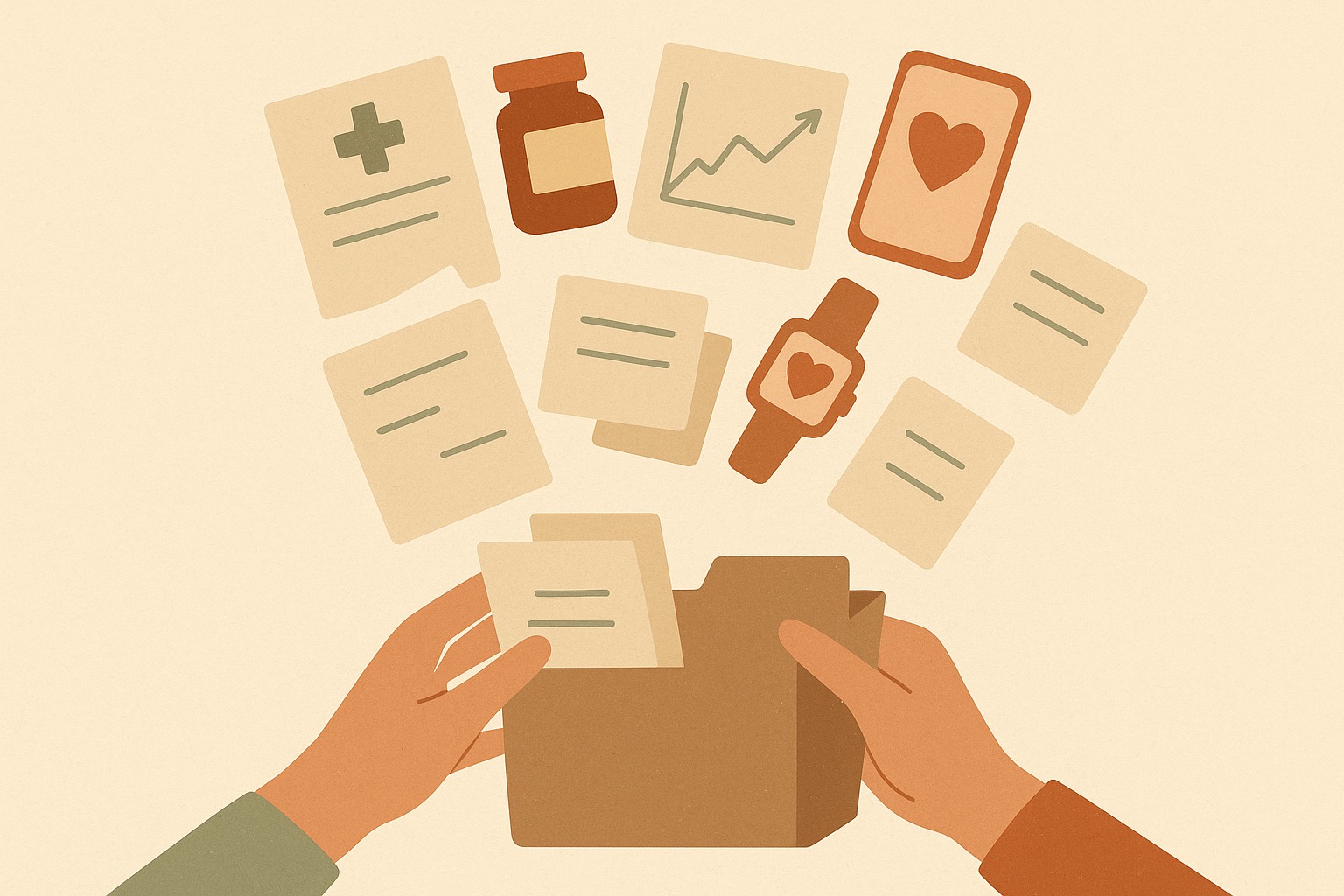
Most people use AI for scraps: write this email, summarize that. I think the bigger win is handing it a whole tedious project. Here’s the one I’d pick: my medical records.
Years ago, long before these AI tools existed, I set out to get all twenty-five years of my medical records in one place. I listed every place I’d gotten care since my twenties, including old doctors in cities I don’t live in anymore. Then I called each office and learned its records-request process (every one is different). I sent the forms and chased them for weeks.
It worked. But for months I was the one keeping track of everything. That slog is exactly the kind of job AI is good at now.
The easy part and the hard part
A lot of your health data is already within reach: MyChart and the other patient portals, Apple Health, Oura, your watch. Most people never export it.
But portals only show recent care from providers you see now. The doctor from two cities ago takes real legwork. That’s the part I did by hand, and it’s the part I’d hand to AI today.
Let the AI run the project
If I started today, I’d ask Claude or ChatGPT to be my project manager and have it:
- Interview me to build the full list of everywhere I’ve gotten care
- Find the medical-records contact for each provider
- Draft each request letter (HIPAA gives you the legal right to your own records, and the AI knows the language)
- Make a checklist I can open in my browser to track what’s sent, what’s back and what’s stuck
Expect two things, because I hit both. Some providers charge a small fee for copies. And they’re allowed up to about 30 days to respond, so replies trickle in over a few weeks. The checklist keeps it from falling apart in the meantime.
Then make it useful
A pile of PDFs isn’t much better than a filing cabinet. So I pulled everything into one private view and charted what I cared about: lab values across years, sleep, activity.
Then I asked the AI, “what do you notice here that I should ask my doctor about?” One thing it flagged: my pneumococcal (pneumonia vaccine) antibody levels were low across most strains, even though my overall immune numbers looked normal. My body didn’t seem to have responded to the vaccine the way you’d expect. No single portal would have shown me that.
This is not a diagnosis, and neither you nor the AI is a doctor. What you get are good questions to bring to an appointment. I read everything it flagged and corrected anything that was off before I trusted it. Treat it like a well-read friend who read your whole chart, not as medicine.
I also made a one-page summary I can hand to a new doctor. No more rebuilding my history from memory in a waiting room.
Keep it private
You’re about to put the most sensitive data you own in one place. The real risks are boring: a shared family computer, an unencrypted cloud folder, a lost laptop. Or pasting your whole record into some app you found that afternoon.
- Keep the archive in one folder on your own device, not the family computer.
- Turn on full-disk encryption (FileVault on a Mac, BitLocker on Windows). Then a lost laptop is a lost brick, not a data breach.
- Password-protect or encrypt the folder itself for a second layer.
- Be careful what you paste into AI tools. You can ask “what do low pneumococcal antibody levels usually suggest?” without your name, birthdate and whole history attached.
- If you back it up, back it up encrypted. Not to a plain Dropbox or Google Drive folder that syncs everywhere.
The AI can walk you through each of these too. Ask it how before you start collecting anything.
Where to start
Paste this into Claude or ChatGPT:
I want to collect all of my medical records from the last 20–25 years into one private, organized archive on my own computer. Act as my project manager. First, interview me to build a complete list of every place I’ve received care. Then help me find each provider’s medical-records contact, draft a formal records-request email for each one, and create an HTML checklist I can open in my browser to track the status of every request. Before we start, walk me through how to keep this data private and secure on my device, in plain language. I’m not very technical.
Start with the easy part you can grab today, then work backward through the older providers. Once the records are in, build the charts and ask it what it notices.
The records were never really the point. The point is that you can just do this now, and most people have no idea.
More in my Building in Public series.