When people talk about AI right now, they mostly talk about what scares them: the environment, the companies leading AI, what happens if AI spins out of our control…
But what about what we WANT from AI, long term? What about the future we should be driving toward? Because I believe that a central failing of human nature is to worry too much about the consequences and worry too little about fixing our eyes on the goal and heading in that direction.
There’s something I’ve seen on social media so often lately that I’m reminded of it now: Someone comments—or posts a picture of a comment, because that’s what we do now on places like Reddit—about “what happened to the ozone hole problem?” And someone else replies something like, “Yeah, we identified a problem and the whole world came together to fix it and we did.” (It isn’t fully healed yet, but thanks to the Montreal Protocol it’s on track to recover over the next few decades.)
Now is the time for visionary leadership. I hate to jinx it, here, but all the signs sure do look like the Democrats are headed toward a massive victory in November (assuming the Republicans don’t meddle to the point of undermining it). And if that’s the case, we’re probably on track for an election much like Obama’s: sweeping change. The best time for optimism, hope, and a plan to save the world.
So I want to try. Here’s where I think we should be going:
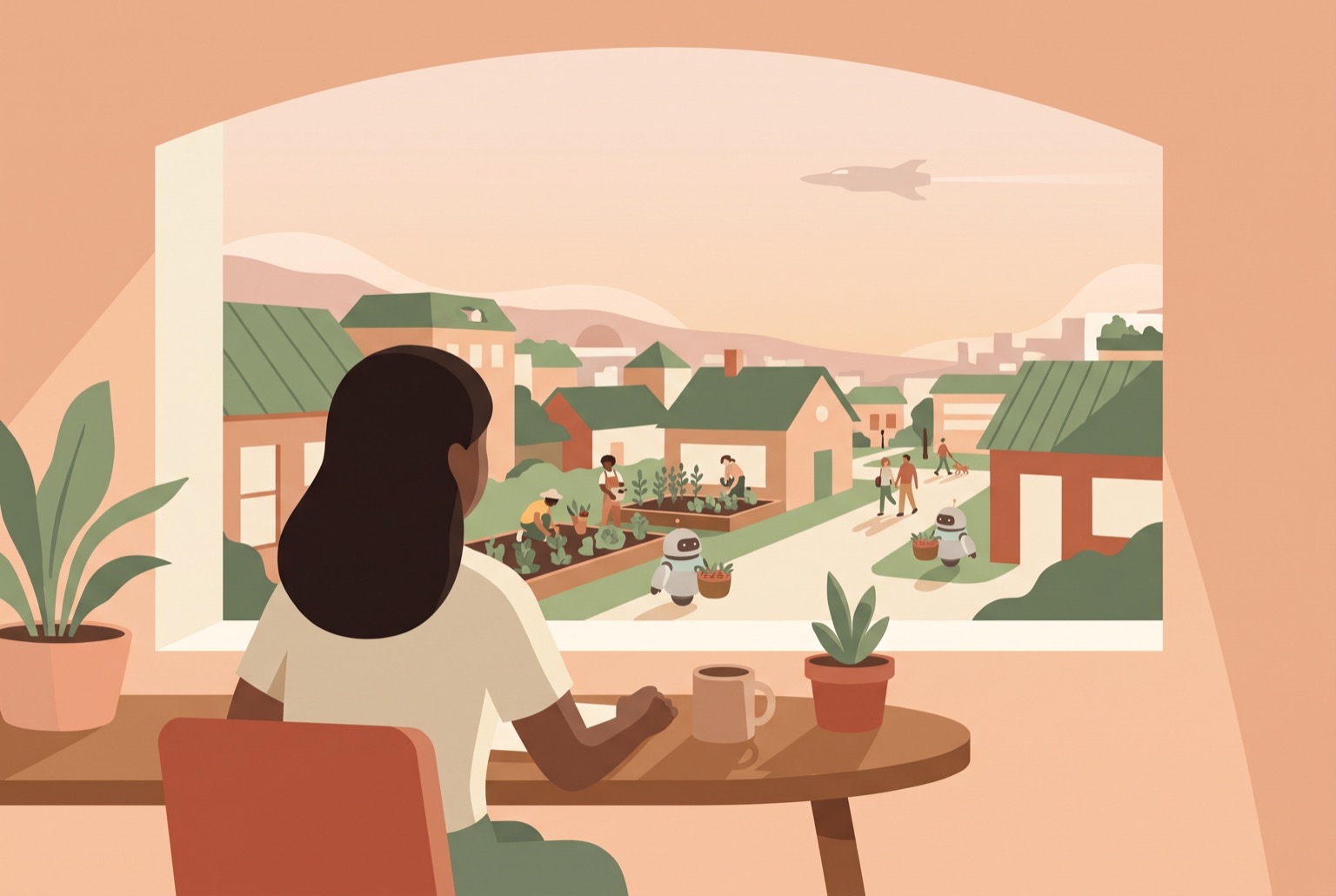
A world where every person gets a birthright grant so large that nobody ever has to think about money. Nobody living in poverty, nobody going hungry, and good health that doesn’t depend on who you work for. A world that’s mostly at peace, because so much of what people have fought over has stopped being scarce. And most of the work that makes it possible gets done by smart AI and robotics, so the people living there can spend their lives on whatever they think is worth doing.
I’ve been calling it “the generous future.” If it sounds like a TV show to you, that’s because it is one.
Where I got it
I watched a lot of Star Trek growing up. I remember my dad’s fascination with The Original Series and the launch of The Next Generation, and that’s stayed with me ever since. A few years later, the internet was opening up to the public through AOL and services like it, and that’s where I started a fan community for Star Trek that persists to this day.
The part that stuck with me was never (just) the starships. It was the society behind them. The show imagined a future where nobody needed money, where people worked because they wanted to get better at something, and where the hard problems were moral rather than economic. As a kid I assumed that was just where humanity was headed. It took me a while to realize most adults filed it under fantasy.
Patrick Stewart, who played Captain Jean-Luc Picard, died on October 28 at 86. For me, Picard was the clearest picture of that society: a man who never had to think about money, whose hardest problems were about doing the right thing. Much of what I’m describing in this post, I first saw in him.
I bring up the show because fiction did something here that policy papers can’t: It let you see what the finished thing would feel like to live in. That’s the piece I think is missing from how we talk about AI.
Why now
For most of history this kind of future was a wish, because the math didn’t work. Food, housing, medicine, care and teaching all take human labor, and human labor is limited and expensive. You can share out what exists more fairly (and we should!), but you can’t give everyone a life without want when there isn’t enough to go around.
AI might change that math. The price of the thinking part of work is already falling fast. In 2025 Epoch AI, a research group that tracks these costs, found that the price of getting GPT-4-level answers on PhD-level science questions was dropping by about 40 times a year. Robotics is further behind, but it’s moving too. Put them together and, maybe for the first time, there’s a real argument that the cost of most labor could fall close to nothing.
We also have some early evidence about what happens when you simply give people money. In Stockton, California, 125 people got $500 a month, no strings, for two years. In the first year, full-time work among recipients rose from 28% to 40%, while it rose from 32% to 37% for people who didn’t get the money. Less than one percent of the money went to alcohol or tobacco. A bigger study run by OpenResearch gave 1,000 people $1,000 a month for three years, and the picture there was more mixed: Recipients worked about 1.3 fewer hours a week and were about 2 percentage points less likely to be employed, but they were also more likely to be looking for a job and to have applied for one.
None of that proves the generous future works. These were modest amounts of money in a world where everything still costs what it costs. What it does undercut is the most common objection I hear, that people with money and no obligation will just sit on the couch.
“That’s naive”
I can hear the bigger objection already: Utopia is naive; scarcity isn’t a temporary problem, it’s the human condition; attempts to build a perfect society have gone badly, sometimes horribly; people are greedy, power piles up in a few hands, and anyone with a plan for paradise is either a fool or selling something.
I think that objection is right about blueprints. A detailed plan for the perfect society tends to go wrong because somebody has to impose it on people who never asked for it.
But naming where you want to end up is a different thing from drawing the plans. Nobody hears “no one should go hungry” and objects that the implementation details are fuzzy. It’s the line you hold every actual policy up against.
What worries me a lot more than sounding naive is that the people building these systems already have a destination in mind. They just don’t say it out loud, and it tends to get set by whatever their investors need next quarter to look like. If the rest of us won’t name a destination because we’re afraid of sounding starry-eyed, we’ll end up with theirs.
That’s why I’m pro-AI, and it’s also why I’m a progressive about it. The technology could carry us a long way toward the generous future. Whether it does comes down to who owns it and who it answers to. Those are political questions, and I worry the left is about to sit them out.
Where I want to go from here
I don’t have this figured out. I want to keep thinking about it out loud: what a birthright grant big enough to forget about would actually take, what work means when you don’t have to do it, what health care looks like when it isn’t anyone’s profit center, and who should own the machines that make all of it possible.
The worries are real, and I’ll keep having them. I’d just like to know where we’re headed first.